Agarwal Gotras
Agarwal Gotras and Their Origin :
In traditional Hindu society, Gotra is more than just a surname or title—it represents one’s spiritual heritage. A person belonging to a particular Gotra is seen as a descendant of that sage and is therefore spiritually considered part of the same extended family as others with the same Gotra.
Due to this, Hindu marriage customs discourage or outright prohibit marriage between individuals of the same Gotra. It is viewed as marrying someone from your own lineage, which is traditionally equated with marrying a biological sibling. This is one of the many ways Hindu society aimed to maintain both genetic diversity and spiritual sanctity in familial relationships.
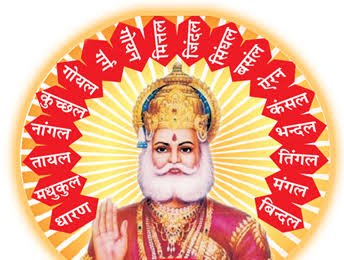
Maharaj Agrasen established the republican state of Agroha. Agroha consisted of 18 state units. The head of each state unit was given a Gotra. All the residents of that particular state unit were identified by that Gotra. It was maintained by Maharaj Agrasen that a nupital alliance could not take place in the same Gotra. That is a girl of "Goel" Gotra could not marry a "Goel boy", but could be married in any of the other 17 Gotra. This rule enunciated by Maharaj Agrasen promoted harmony and brotherhood among all the 18 Gotra represented by state units. This facilitated promotion of unity and nationalism among the state units.
The Surname Agrawal was derived by taking 'Agra' from Agrasena and 'wal' ('wal'originally being 'bal' was taken from the word Baalak meaning child). The word Agrawal effectively means Son of Agrasena. Many Agrawals have adopted their gotra name as their surname. Gupta is a common surname adopted by some Agrawal's, and several partial Agrawal families like Gadia, Saini, Vishnoi and Varshney (majorly found in western Uttar Pradesh and are the progenies and followers of Sri Akrur Ji Maharaj). Varshney (or Barahseni) is a version of a name, first used by Arjuna to address Krishna in the Mahabharata Chapter 1, Shloka 41, Swami Sivananda translation). There is some debate over whether Varshneys belong to the Vaishya (merchants and artisans or Kshatriya (warriors, rulers and politicians) caste.In addition, many others use surnames linked with the place of their origin, for example Jhunjhunwala, Kedia, Gindodiya, Kalothia, Dokania, Lohia, Chamaria, Singhania etc.
| Gotra | Original Gotra | Saint (Guru) | Branch | Sutra |
| Airan/Aeron |
Aurva |
Atri/Aaurva |
Madhyadini/Madhuri |
Kaatyayni |
| Bansal |
Vatsya |
Vishist/Vatsa |
Kouthmi/Kauttham |
Gobhil |
| Bindal/Vindal |
Vishist |
Yavasya/Vashista |
Madhuri |
Kaatyayni |
| Bhandal |
Dhoumya |
Bhardwaj |
Madhyadini/Madhuri |
Kaatyayni |
| Dharan/Deran |
Dhanyas |
Bhekaar/Ghaumya |
Madhuri |
Kaatyayni |
| Garg/Gargeya |
Gargasya |
Gargacharya or Garg |
Madhuri |
Kaatyayni |
| Goyal/Goel |
Gomil |
Gautam/Gobhil |
Madhuri |
Kaatyayni |
| Goyan/Goin/Goyanor/Gangal |
Gautan |
Purohit/Gautam |
Madhyadini/Madhuri |
Kaatyayni |
| Jindal |
Gemino |
Bruhaspati/Jaimini |
Madhyadini/Madhuri |
Kaatyayni |
| Kansal |
Kaushik |
Kaushik |
Madhyadini/Madhuri |
Kaatyayni |
| Kuchhal/Kachal/Kuchchal |
Kashyap |
Kush/Kashyap |
Kosami/Kauttham |
Komaal |
| Madhukul/Mudgal |
Mudgal |
Aashvalayan/Mudgal |
Saalaya/Sakalya |
Aslayin |
| Mangal |
Maandav |
Mudragal/Mandavya |
Sakalya |
Asusai |
| Mittal |
Maitreya |
Vishwamitra/Maitreya |
Madhyadini/Madhuri |
Kaatyayni |
| Naagil/Nangal/Nagal |
Naagend |
Kaudalya/Nagendra |
Kouthmi/Kauttham |
Aslayin |
| Singhal/Singla |
Shandalya |
Shringi/Shandilya |
Koyumi/Kauttham |
Gobhil |
| Tayal |
Taitireya |
Saakal/Taitireya |
Madhyadini/Aausthambh |
Kaatyayni |
| Tingal/Tunghal |
Taandav |
Shandilya/Tandya |
Madhyadini/Madhuri |
Kaatyayni |